If you’ve ever walked past a substation on a road trip or wondered how your city’s power stays on during storms, you’ve probably passed a high-voltage circuit breaker without even noticing. As someone who’s worked in the circuit breaker supply game for over a decade, I get that most folks don’t think about these little (okay, sometimes big) devices until something goes wrong. Let’s break it down simply—no jargon overload, just straight talk about what they are and where they actually get used. Circuit Breaker

First off, what’s a high-voltage circuit breaker, anyway? Let’s start with the basics: every power grid has a job. It takes electricity generated at a power plant (that could be a coal, natural gas, wind, or solar plant), cranks up the voltage so it can travel long distances without wasting too much energy, and then cranks it back down when it gets to your neighborhood or factory. A circuit breaker is the safety switch of this whole system—way more robust than the little ones in your house that flip when you plug too many space heaters into one outlet.
The “high-voltage” part is key here. Household outlets are 120 or 240 volts, but high-voltage breakers deal with anything above 1,000 volts—and usually way above that, like 35,000 volts or even 800,000 volts for long-haul power lines. Why does that matter? Regular breakers are designed for low, steady power; high-voltage ones have to handle way more energy, and they have to do it fast—like, in less than a thousandth of a second—when something goes wrong. If a power line hits a tree or a storm knocks a line loose, that creates a short circuit that can send a massive surge of power. A high-voltage breaker’s job is to snap that circuit shut (wait, no—wait, to snap it open, actually) instantly to stop that surge from frying power lines, transformers, or even the power plant itself.
A lot of people mix up breakers with fuses, but they’re not the same. Fuses are one-and-done—they blow when a surge hits and you have to replace them. High-voltage breakers are reusable. After a fault clears, a technician can reset the breaker and get the power back up in minutes, instead of waiting for a new fuse to ship and install. That’s a big deal for keeping power outages short, especially for big cities or industrial sites.
Now, where do these bad boys actually get used? Let’s go through the main spots, because it’s not just substations—though those are the big ones.
First up, transmission substations. These are the places where power plants send long-distance lines. When a plant generates electricity, it’s stepped up to super high voltage (like 230,000 volts) to travel hundreds of miles. Along those lines, there are substations every so often, and each of those has high-voltage breakers. Why? If a line goes down halfway, the breaker can isolate that section so the rest of the grid doesn’t get dragged into the problem. Imagine a 500-mile power line: if one end had a breaker that didn’t work, a surge from a fault could damage every transformer and substation along the whole line instead of just the one spot. That would mean a city-wide outage that lasts for days, not hours.
Next, distribution substations. These are the substations closer to residential areas, where the voltage is stepped down from super high to something that neighborhood transformers can handle (like 12,000 volts). These breakers are a little smaller than transmission ones, but they’re still high-voltage. They split the power from the main transmission line into smaller lines for different neighborhoods. If a car hits a distribution pole and knocks a line down, the breaker for that neighborhood section trips right away, so only that block loses power instead of the whole city. That’s why you might see a big utility truck fixing a single street instead of the whole downtown.
Then there’s industrial facilities, and I’m not talking about a small factory with a few machines. I’m talking about big stuff: steel mills, chemical plants, mining operations, data centers. These places use way more power than a neighborhood. A steel mill, for example, has giant furnaces that run 24/7 and need a steady, unbroken power supply. If the power cuts out even for a second, those furnaces can solidify, which costs millions to fix. High-voltage breakers are installed at the main power intake for these facilities, and they also protect the internal circuits for heavy equipment. Plus, many industrial sites have their own backup generators, and high-voltage breakers coordinate between the grid and the generators to make sure power doesn’t flow back into the grid when it’s supposed to be isolated— that’s a safety thing for line workers who might be fixing lines.
Renewable energy farms too—wind and solar, specifically. Here’s a thing: a wind farm has hundreds of turbines, each generating power. That power has to be collected and sent to the grid, so each turbine has a small breaker, and then the main collection point for the whole farm has big high-voltage breakers. If one turbine has a fault, the breaker for that turbine trips, so the rest of the farm keeps running. For solar farms, same idea: the panels generate DC power, which gets turned to AC, and the breakers there protect the inverters and the grid connection. As more and more people switch to wind and solar, demand for high-voltage breakers for these sites has blown up (pun totally intended).
Oh, and let’s not forget about emergency response and critical infrastructure stuff. Like, when a hurricane or tornado hits, utility crews use mobile substations that have portable high-voltage breakers to restore power fast. Hospitals, police stations, fire departments—these places have dedicated high-voltage breakers that make sure their backup power systems kick in immediately if the grid goes down. No one wants a power outage at a hospital when someone’s in surgery, right? The breaker ensures that the shift from grid to generator is seamless.
Now, as a circuit breaker supplier, I can tell you that it’s not a one-size-fits-all thing. A breaker for a wind farm in the Great Plains is different from one for a steel mill in Ohio, which is different from a substation in a dense city. We don’t just sell a box and walk away—we work with clients to figure out what they need: do they need a breaker that can handle super high voltage for long-distance transmission? Or a more compact one for a small distribution substation? Do they need a breaker that works in extreme cold (like in Canada) or extreme heat (like in the Southwest)? We test every breaker to make sure it can handle the conditions it’s going to face, because if a breaker fails when a storm hits, that’s not just a broken part—that’s a big headache for everyone.
A lot of people don’t realize how much these devices impact their daily lives. The next time you lose power for 10 minutes during a storm instead of 10 hours, thank a high-voltage circuit breaker. The next time your city’s data centers stay online during an outage, thank a high-voltage circuit breaker. The next time a wind farm keeps sending power to your house even if one turbine breaks, thank a high-voltage circuit breaker.
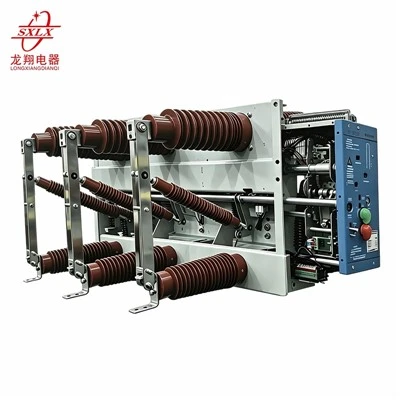
If you’re in the market for reliable high-voltage circuit breakers for your substation, industrial site, renewable farm, or any other project, we’re here to help. We’ve got years of experience working with utilities, industrial operators, and renewable energy teams to find the right breaker for their needs, no matter how big or small the job is. Just reach out to us to chat through your requirements—we’re happy to answer questions, provide specs, and make sure you get the right equipment to keep your power running smoothly.
40.5kV Vacuum Circuit Breaker References
- IEEE Std C37.04-2017, IEEE Standard for Rating Structure for AC High-Voltage Circuit Breakers Rated on a Symmetrical Current Basis
- North American Electric Reliability Corporation (NERC), 2023 Grid Reliability Report
- U.S. Energy Information Administration (EIA), Renewable Energy Infrastructure Needs: 2022 Update
- National Fire Protection Association (NFPA), NFPA 70E-2021, Standard for Electrical Safety in the Workplace
- International Electrotechnical Commission (IEC) 62271-100:2017, High-voltage switchgear and controlgear – Part 100: alternating-current circuit breakers
Shaanxi Longxiang Electrical Co., Ltd.
Shaanxi Longxiang Electrical Co., Ltd. is one of the most professional circuit breaker manufacturers and suppliers in China, also accepts customized orders. We warmly welcome you to buy advanced circuit breaker made in China here from our factory. Quality products and reasonable price are available.
Address: No. 619, Gaoxin Avenue, Comprehensive Bonded Zone, High-tech Development Zone, Baoji City, Shaanxi Province, China
E-mail: lee@longxiangelectric.com
WebSite: https://www.longxiang-electric.com/
